R-Value Explained: What It Means for Your Home
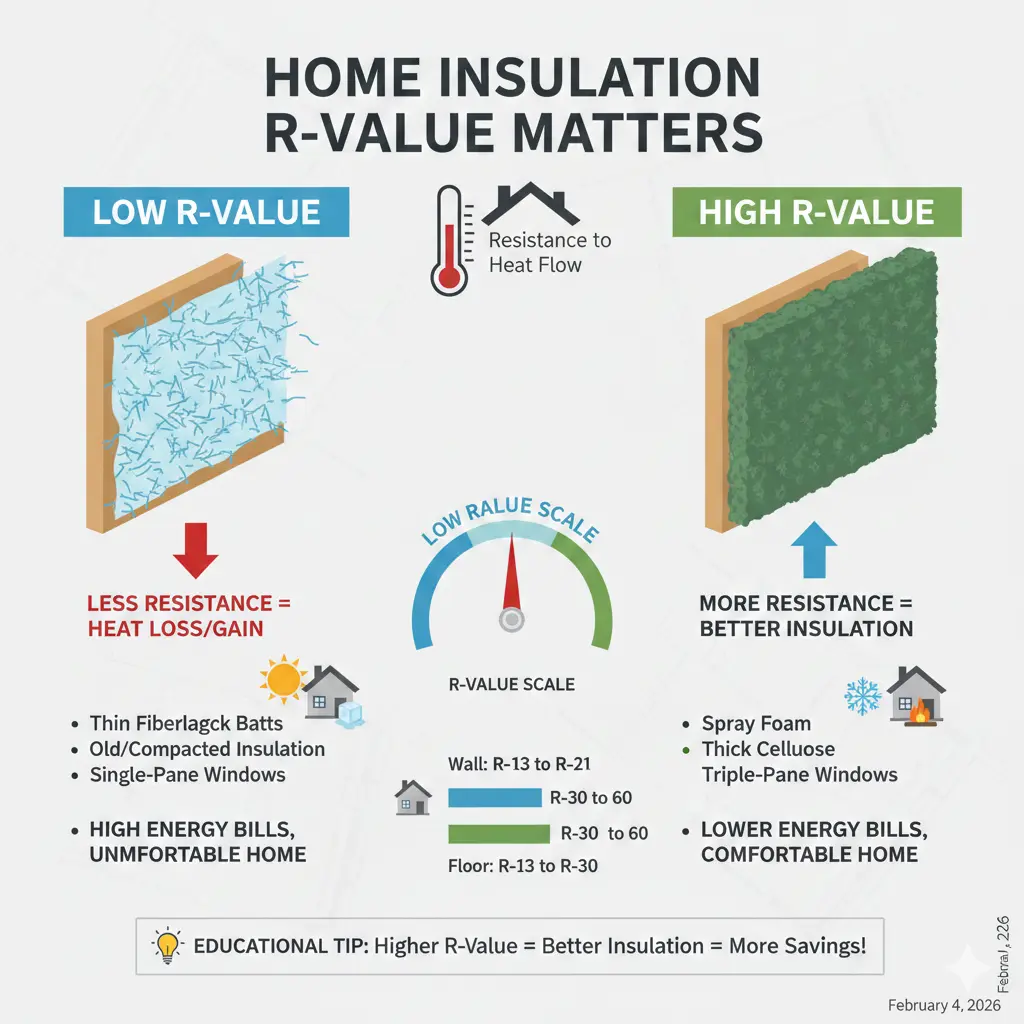
R-value is the measurement most homeowners see when they start comparing insulation, but it is also one of the most misunderstood. At its simplest, R-value measures how strongly a material resists heat flow.
Higher numbers mean greater thermal resistance, but that does not mean every product with the highest number is automatically the best choice for every part of the house.
What makes R-value confusing is that the number is only part of the story. The label on the bag or board reflects standardized lab testing, while the comfort and efficiency you feel in a real home also depend on air leakage, moisture, gaps, compression, settling, and the way the whole wall, attic, or floor assembly is built.
That is why two homes with the “same R-value” on paper can perform very differently.
This guide is built to help homeowners understand the number in a practical way. It covers what R-value is, how it is rated, the typical range by insulation type, how much insulation different climate zones usually call for, and how R-value relates to sound reduction.
What R-Value Is
R-value is a measure of thermal resistance. In plain English, it tells you how strongly insulation slows conductive heat transfer. The higher the R-value, the better the material is at resisting that heat flow under the test conditions used to rate it.
That definition matters, but it is just the starting point. The notes that R-value depends on the insulation type, thickness, and density, and that performance can also be affected by temperature, aging, and moisture.
The same guidance also explains that when you install multiple layers, the R-values add together.
What R-value does not do is describe everything that makes a home comfortable. It does not directly measure air leakage, which is why drafty homes can still feel uncomfortable even after insulation is added.
It also does not directly measure sound control, which is why a product with a respectable R-value may still do only a modest job of quieting a noisy room or street if the full wall or ceiling assembly is weak.
- Product R-value:
- the tested thermal resistance of the insulation material or layer itself.
- Installed performance:
- what you actually get after thickness, fit, compression, settling, moisture, and detailing are accounted for.
- Whole-assembly performance:
- how the full wall, attic, or floor performs once framing and thermal bridges are included.
The DOE notes that radiant barriers do not have an inherent R-value. They work differently by reflecting radiant heat rather than acting like thick fibrous or foam insulation.
How R-Value Is Rated and Determined
The reason R-value is useful at all is that, in the United States, it is tied to standardized testing and labeling rules.
The FTC’s R-value rule requires insulation manufacturers, retailers, installers, and new-home sellers to provide R-value information based on standard tests so homeowners can compare products on a more consistent basis.
For most insulation materials, the governing rule points to ASTM test methods such as C177, C518, C1363, and C1114. Those tests are run at a mean temperature of 75°F with a temperature difference of 50°F, plus or minus 10°F.
The rule also says the material must be tested alone, without any added airspace, unless the product is a reflective system being evaluated under the reflective-insulation provisions.
The deeper nuance is where many homeowner pages stop too early. Some materials must be tested in ways that reflect how they change over time. Polyurethane, polyisocyanurate, and extruded polystyrene must be tested on samples that reflect aging effects.
Loose-fill cellulose must be tested at settled density. Loose-fill mineral wool, stabilized cellulose, and spray-applied cellulose must reflect settling or specified installed density.
That is exactly why rough “per inch” rules can be useful for quick orientation but should never replace the labeled full-thickness value and product fact sheet.
The FTC goes even further: sellers generally are not supposed to make simple “R-value per inch” claims unless actual test results show the product’s per-inch value does not drop as thickness increases.
In other words, use per-inch charts as a shortcut for understanding categories, but use the product label and installation thickness as the final decision tool.
Key Facts
- Most residential insulation R-values are tied to ASTM tests named in federal labeling rules.
- Standard test conditions matter because thermal performance changes with temperature and, for some foams, age.
- Loose-fill products must be evaluated in ways that reflect settling or installed thickness, not just fluffy bag condition.
- The product label and seller fact sheet are more reliable than a generic chart when you are buying insulation.
A homeowner-friendly way to think about the FTC rule is this: the government wants R-value claims to be apples-to-apples, not marketing guesses. That is why the rule ties labels and fact sheets back to standard test methods and product conditions such as aging, settled density, and installed thickness.
R-value is not a made-up marketing score. It is a standardized thermal metric. But the number only becomes useful when you pair it with product thickness, installation conditions, and the right assembly for the part of the house you are insulating.
Typical R-Value Ranges by Insulation Type
For homeowners, the easiest way to compare insulation families is still the rough “R-value per inch” shortcut. Used carefully, it helps you understand which materials are space-efficient and which ones rely more on added depth.
Used carelessly, it can mislead you, because thickness, density, aging, and product formulation all change the final number. The ranges below are best treated as typical homeowner guideposts, not substitutes for the labeled product value.
The table below synthesizes published values and typical product examples from the DOE, cellulose and spray foam trade groups, and manufacturer technical pages.
Where there is variability, the safest homeowner takeaway is simple: compare the full labeled R-value at the installed thickness you actually intend to use, not just the headline “per inch” number.
Typical Residential R-Value Ranges by Insulation Type
| Insulation type | Typical R-value per inch | Homeowner note |
|---|---|---|
| Fiberglass batt / roll | About R-3.1 to R-4.3 | Widely available and budget-friendly. Fit and compression matter a lot. |
| Cellulose | About R-3.6 to R-3.7 | Dense fill helps cover gaps well in attics and retrofit walls. |
| Mineral wool batt / board | About R-4.0 to R-4.2 | Strong thermal, fire, and sound-control balance. |
| Open-cell spray foam | About R-3.6 to R-3.8 | Adds air sealing along with insulation. |
| Closed-cell spray foam | About R-5.7 to R-7.0 | High R in limited space, but cost and aging context matter. |
| EPS rigid foam | About R-4.0 | Steady baseline rigid-foam option; usually needs more thickness. |
| XPS rigid foam | About R-5.0 | Higher per inch than EPS; aged performance matters. |
| Polyiso rigid foam | About R-5.0 to R-6.0+ | Very strong per-inch thermal performance, but cold-weather conditions can affect measured resistance. |
| Radiant barrier / reflective insulation | No inherent R-value by itself | Works by reducing radiant heat gain, not by acting like fiber or foam insulation. |
A few practical conclusions flow from this table. If you are insulating an open attic floor, lower-cost fibrous materials can still reach high total R-values because you have room for depth.
If you are working in a shallow wall, rim joist, or another tight cavity, higher per-inch products can be attractive because space is the constraint.
And if you are insulating the outside of a wall, rigid continuous insulation can help reduce thermal bridging through studs, which improves real assembly performance beyond the cavity label alone.
What R-Value You Need in Your Area
The “right” R-value is not one universal number. The DOE says it depends on your climate, your heating and cooling system, and the specific part of the house you are insulating.
That is why attic recommendations are much higher than floor or wall recommendations in colder zones, and why basement or crawlspace guidance is its own category instead of an afterthought.
For homeowners, the clearest way to use R-value guidance is as a three-step filter:
- First: Find your climate zone.
- Second: Decide whether you are insulating an attic, floor, wall, basement, or crawlspace.
- Third: Look at the recommended range for that location and compare it with what is already installed. In many real projects, the best move is not to buy “the highest number” but to hit the right target with an installation that also addresses air leaks and moisture.
Find Your Climate Zone
Enter your ZIP code to see your IECC climate zone and recommended insulation R-values.
R-value ranges shown are general DOE guidance and may vary based on building type, existing insulation, and local building codes.
The quick-reference chart below adapts the DOE’s current existing-home insulation guidance for attics, floors, and above-grade wood-frame walls.
The wall column looks more complex because many zones now use combinations of cavity insulation and continuous exterior insulation, not just a single cavity number.
Quick Climate-Zone R-Value Guide for Existing Homes
| Climate zone | Uninsulated attic | Attic with 3–4 in. existing insulation | Uninsulated floor | Above-grade wood-frame wall |
|---|---|---|---|---|
| 1 | R-30 to R-49 | R-19 to R-38 | R-13 | R-13 or R-0 + R-10 CI |
| 2 | R-49 to R-60 | R-38 to R-49 | R-13 | R-13 or R-0 + R-10 CI |
| 3 | R-49 to R-60 | R-38 to R-49 | R-19 | R-20 or R-13 + R-5 CI or R-0 + R-15 CI |
| 4 except marine | R-60 | R-49 | R-19 | R-20 + R-5 CI or R-13 + R-10 CI or R-0 + R-15 CI |
| 4 marine and 5 | R-60 | R-49 | R-30 | R-20 + R-5 CI or R-13 + R-10 CI or R-0 + R-15 CI |
| 6 | R-60 | R-49 | R-30 | R-20 + R-5 CI or R-13 + R-10 CI or R-0 + R-15 CI |
| 7 and 8 | R-60 | R-49 | R-38 | R-20 + R-5 CI or R-13 + R-10 CI or R-0 + R-15 CI |
If you are insulating a basement or crawlspace wall, ENERGY STAR’s homeowner guidance adds a narrower set of recommendations based on the 2021 IECC.
This is one of the easiest places for homeowners to miss the mark, because basement walls are often treated like “extra” insulation when they are really part of the envelope.
Basement and Crawlspace Wall Recommendations
| Climate zone | Basement or crawlspace wall target |
|---|---|
| 3 | Add R-5 insulative wall sheathing or R-13 batt |
| 4A and 4B | Add R-10 insulative wall sheathing or R-13 batt |
| 4C and 5–8 | Add R-15 insulative wall sheathing or R-19 batt |
These charts are strong starting points, not the only word. The DOE also notes that energy-efficient new homes often go beyond minimum code, and detailed requirements can vary by assembly type and local code adoption.
Use these numbers to narrow the field, then verify the final target for your ZIP code, wall type, and project scope.
For most homeowners, the attic is where the highest target shows up first, walls come next, and floors or foundation assemblies vary by climate and assembly type. The right move is to use your zone, pick the assembly, and then decide whether depth, air sealing, or continuous insulation is the limiting factor.
What Affects Real-World Performance
A labeled R-value tells you something important, but it does not guarantee the same result once the insulation is inside your house.
Air leakage is one of the biggest reasons why. DOE building-science guidance explains that comprehensive air sealing can reduce utility costs while also improving comfort, indoor air quality, noise control, and durability.
If outside air is still moving freely through penetrations and gaps, insulation cannot fully do the job homeowners expect it to do.
Installation quality matters just as much. The DOE notes that R-value depends on thickness and density, while ENERGY STAR’s insulation fact sheet warns that compressed insulation does not deliver its full rated R-value.
That is why batts need full contact and proper fit, and why loose-fill products have to be installed to the correct settled depth rather than judged by how fluffy they look on day one.
Thermal bridging is another major reason labeled R-value and felt comfort do not always match. Building-science guidance explains that framing members act as lower-R pathways that let heat bypass the cavity insulation.
Exterior rigid insulation or other continuous insulation strategies help by carrying insulation across the framing instead of only between studs.
Moisture and time also matter. The DOE notes that moisture accumulation can affect R-value, and the FTC rule requires certain materials to be tested in ways that reflect aging or settling because those changes alter real performance.
Homeowners should treat this as a reminder that “what is inside the wall” and “what lasts in the wall” are not quite the same question.
The FTC rule specifically requires polyurethane, polyisocyanurate, and extruded polystyrene samples to reflect aging effects, and loose-fill cellulose to be tested at settled density.
Sound Deadening Capabilities
Sound control is where many R-value pages become misleading. R-value is a thermal metric. It tells you about resistance to heat flow, not how much conversation, traffic, plumbing, or TV noise will pass through a wall or ceiling.
For sound, the more useful homeowner metric is usually STC, or Sound Transmission Class, which rates how a full assembly reduces airborne sound.
That distinction matters because sound performance is an assembly problem, not just a material problem.
The HUD noise guide explains STC as a way to compare the sound reduction of alternative constructions, while ROCKWOOL’s acoustic guidance emphasizes that STC belongs to the wall or floor system, not just the insulation stuffed inside it.
In other words, a good batt inside a weak, leaky wall is not the same as a well-sealed, layered, assembly-tested partition.
Insulation still plays an important part. Dense and fibrous materials help absorb sound energy inside cavities and reduce resonance. The cellulose trade group says cellulose is commonly used to help limit exterior noise and room-to-room noise because it fills joints, crevices, and gaps.
ROCKWOOL positions both its exterior Comfortbatt and interior Safe’n’Sound products as strong noise-reduction options, and its Safe’n’Sound guidance specifically points homeowners to interior walls, floors, and ceilings where privacy and noise control matter.
Fiberglass can also be part of a sound-control strategy, especially in products made specifically for interior acoustic partitions. Owens Corning markets dedicated fiberglass sound attenuation batts to reduce noise transfer between rooms.
But the larger lesson remains the same across materials: ask what the assembly has been tested to do, not just what the material’s R-value is.
A good homeowner rule of thumb is this: if comfort and energy are the goal, start with proper R-value and air sealing; if privacy and quieter rooms are also important, choose an assembly designed for that purpose.
Air sealing helps because where air leaks, sound often rides along. Then cavity insulation, drywall layers, framing type, and assembly details determine how strong the final result will be.
Higher R-value does not automatically mean a quieter home. For noise, think in terms of airtightness plus assembly-tested sound control, with dense cavity insulation helping the wall or floor do its job.
FAQs
There is no single attic number that fits every home. DOE guidance ranges from R-30 to R-49 in Zone 1 up to R-60 in colder zones, with separate guidance when an attic already has 3–4 inches of insulation.
Not always. High per-inch products are especially useful where space is tight, but in open attics, lower-cost fibrous insulation can still reach the needed total R-value by adding depth. Air sealing, moisture control, and installation quality still influence the final result.
No. If air leaks remain, moisture issues are present, or insulation is compressed or poorly installed, comfort can still be disappointing. DOE building-science guidance specifically ties airtightness to comfort and durability, not just energy use.
No. Sound control is measured at the assembly level, usually with STC, not by R-value alone. Cavity insulation helps, but the surrounding wall or floor system matters just as much.
Yes. The DOE notes that the R-values of multilayered installations are added together. Many high-performing walls combine cavity insulation with continuous exterior insulation to reduce thermal bridging.
No. DOE guidance says radiant barriers do not have an inherent R-value. They reduce radiant heat gain differently and should not be treated as a direct substitute for conventional insulation depth.
- R-value measures resistance to heat flow, not air leakage, moisture control, or sound transmission by itself.
- The FTC requires insulation R-values used in labels and marketing to come from standardized tests, with special rules for products affected by aging or settling.
- The right R-value depends on your climate zone, the part of the house you are insulating, and whether the work is a simple add-on or a larger wall or roof assembly upgrade.
- Real-world performance depends heavily on air sealing, installation quality, and thermal bridging through framing.
- If sound control matters, ask about assembly-tested STC performance, not just R-value.
-
U.S. Department of Energy — Insulation https://www.energy.gov/energysaver/insulation
-
U.S. Department of Energy — Types of Insulation https://www.energy.gov/energysaver/types-insulation
-
U.S. Department of Energy — Determining Insulation R-Value https://www.energy.gov/energysaver/determining-insulation-r-value
-
ENERGY STAR — Recommended Home Insulation R-Values (https://www.energystar.gov/saveathome/seal_insulate/identify-problems-you-want-fix/diy-checks-inspections/insulation-r-values)
-
ENERGY STAR — Air Sealing and Insulation https://www.energystar.gov/saveathome/seal_insulate
-
International Code Council (IECC Climate Zones) https://www.energycodes.gov/climate-zones
-
Oak Ridge National Laboratory — Insulation Fact Sheet https://www.ornl.gov/publication/insulation-fact-sheet
-
NAIMA (North American Insulation Manufacturers Association) — What Is R-Value? https://www.insulationinstitute.org/im-a-homeowner/about-insulation/how-insulation-works/
-
CertainTeed — Understanding R-Value https://www.certainteed.com/insulation/resources/understanding-r-value/
-
Johns Manville — R-Value Chart for Insulation Types https://www.jm.com/en/homeowner-insulation/homeowner-faq/what-is-r-value/
-
Owens Corning — Insulation and Sound Control https://www.owenscorning.com/en-us/insulation/applications/residential-interior-acoustics
-
ROCKWOOL — Soundproofing and Acoustic Insulation https://www.rockwool.com/north-america/advice-and-inspiration/blog/what-is-soundproofing-insulation/
-
EPA — Indoor Air Quality and Home Weatherization https://www.epa.gov/indoor-air-quality-iaq/weatherization
-
ASHRAE — Thermal Insulation and Energy Efficiency Resources https://www.ashrae.org/
-
Building Science Corporation — Understanding Heat Flow https://buildingscience.com/documents/digests/bsd-011-thermal-control-in-buildings